
The Best Time to Buy a Home in 2026 May Be Right Around the Corner

For buyers who have been waiting for a sign that the market is finally shifting in their favor, this might be it.

According to recent research from Realtor.com, the week of September 27 through October 3, 2026 is projected to be the best time to buy a home nationally due to a combination of increased inventory, reduced competition, more price reductions, and improved negotiating opportunities. [realtor.com]

While there is never a perfect time for every buyer, the fall market often creates opportunities that simply aren’t available during the busy spring and summer homebuying season.

Why Fall Can Be a Smart Time to Buy

Throughout the spring and summer, buyers typically face the greatest competition. More buyers are actively shopping, desirable homes receive significant attention, and sellers often have less incentive to negotiate.

As we move into the fall, several market dynamics begin to change:

• More homes are available for sale
• Buyer demand begins to slow
• Homes spend more time on the market
• Sellers become more flexible on price and concessions
• Price reductions become more common

For buyers, that can mean more choices, more time to make decisions, and greater leverage during negotiations. [realtor.com]

Inventory Is Giving Buyers More Options

One of the biggest challenges buyers have faced over the last several years has been a lack of available homes.

According to Realtor.com, active inventory during the best week of the year is expected to be approximately 13.3% higher than the average week and nearly 32% higher than the beginning of the year. [realtor.com]

More inventory means buyers are less likely to feel pressured into making rushed decisions and are more likely to find a home that truly fits their needs.

For buyers throughout Georgia and the Southeast, we’re seeing many markets continue moving toward a healthier balance between buyers and sellers.

Less Competition Means More Opportunity

When inventory rises and buyer demand slows, competition naturally decreases.

Realtor.com reports that buyer demand during the projected best week is historically about 30% lower than peak demand periods earlier in the year. [realtor.com]

That means buyers may face fewer bidding wars, fewer escalation clauses, and less pressure to waive important protections such as inspections or financing contingencies.

That’s often a healthier environment for making one of the largest financial decisions of your life.

Price Reductions Continue to Create Opportunities

Another trend benefiting buyers is the increase in price reductions.

Homes that were priced aggressively during the summer months may sit longer as the market slows, prompting some sellers to make adjustments. Realtor.com notes that early fall historically represents one of the strongest times of the year for price reductions. [realtor.com]

While no one can predict exactly how far prices will move, buyers entering the market during the fall often find more room for negotiation than they would have seen just a few months earlier.

What About Mortgage Rates?

If you’ve followed mortgage rates lately, you know they can change quickly.

The reality is that timing interest rates perfectly is nearly impossible.

Instead of waiting for the “perfect” rate, successful buyers typically focus on what they can control:

• Their monthly payment
• Their budget
• Their loan strategy
• Seller concessions
• Temporary or permanent rate buydown opportunities

At Fairway Home Mortgage, we spend a lot of time helping buyers evaluate the full financial picture rather than focusing solely on headline interest rates. The lowest rate doesn’t always mean the best overall mortgage strategy.

Good News for Atlanta Area Buyers

For the Atlanta metro area, Realtor.com identifies the same week of September 27 through October 3 as the strongest buying window of the year. The report cites increased inventory, reduced buyer competition, more days on market, and lower median listing prices compared to annual peak pricing levels. [realtor.com]

Of course, real estate remains hyper-local. Every neighborhood, city, and price point can behave differently. That’s why having a local mortgage and real estate strategy matters.

The Bottom Line

If you’ve been waiting for the market to become more buyer-friendly, this fall may offer one of the strongest opportunities we’ve seen in several years.

More inventory, less competition, additional negotiating power, and improving market balance can create favorable conditions for buyers who are prepared and ready to act. [realtor.com]

The key isn’t trying to perfectly time the market.

The key is being financially prepared when the right home becomes available.

Whether you’re buying your first home, moving up, downsizing, or investing, having a solid game plan can make all the difference.

Ready to Explore Your Options?

Before you start shopping, make sure your financing strategy is in place.

The Shumate Mortgage Team can help you understand your purchasing power, compare loan options, evaluate payment scenarios, and create a plan that fits your goals.


Contact Chris Shumate at Fairway Home Mortgage

(404) 791-3155
chriss@fairwaymc.com
http://chrisshumatefairway.com/

NMLS #627360 | FIMC #2289

*Licensed in GA, FL, AL, TN, SC, NC

Follow Chris Online

Source: Realtor.com Housing Market Research, September 2026.

About Chris Shumate

Chris Shumate is a Sales Manager and Loan Officer with Fairway Home Mortgage and has helped more than 3,500 families achieve the dream of homeownership during his 25+ years in the mortgage industry. Recognized among the Top 1% of Mortgage Originators in America for six consecutive years, Chris is known for providing straightforward advice, creative financing solutions, and a mortgage process built around education and communication.

Whether you’re buying your first home, upgrading, downsizing, or investing, Chris and the Shumate Mortgage Team are committed to helping you make confident mortgage decisions.


The Fed Raised Rates Today. Here’s What It Actually Means for Homebuyers.

The Full Story Is Much More Important.

If you’ve seen today’s headlines, you’ve likely heard that the Federal Reserve raised its key short-term interest rate by 0.25%, moving the target range from 3.50%-3.75% to 3.75%-4.00%.

Whenever the Fed makes a move like this, one of the biggest misconceptions I hear is:

“Mortgage rates just went up by 0.25% too.”

The reality is, that’s not how mortgage rates work.

Mortgage rates are not directly tied to the Federal Funds Rate. Instead, they’re influenced primarily by the bond market, including mortgage-backed securities and longer-term Treasury yields.

Although today’s rate hike was widely expected and much of the market had already priced in the Fed’s decision, investors paid close attention to Fed Chairman Kevin Warsh’s comments during his press conference. As Warsh emphasized that inflation remains “too high” and signaled the Fed remains committed to bringing it under control, Treasury yields moved higher, with the 10-year Treasury climbing back toward the 5% level. While mortgage rates don’t move in lockstep with Treasury yields, they often follow the same general direction. Investors interpreted the Fed’s message as a sign that inflation pressures may persist and that interest rates could remain elevated for longer than previously expected. As a result, bond prices fell and yields rose, creating additional upward pressure on mortgage rates.

The Key Takeaway

Mortgage rates are often influenced less by what the Fed does today and more by what investors believe the Fed will do tomorrow.

Over the past several days, mortgage rates had already been moving higher in anticipation of today’s decision and ongoing concerns about inflation. Much of the market reaction occurred before the Fed’s announcement was made, but the Fed’s comments reinforced concerns that inflation may take longer to bring under control than many investors had hoped.

Currently, national average 30-year fixed mortgage rates are hovering around 7%, and we expect mortgage rates to remain generally in the high-6% to low-7% range in the near term.

Don’t Let the Interest Rate Alone Determine Whether It’s the Right Time to Buy

Too many people focus exclusively on the rate and lose sight of the bigger picture.

Every buyer’s situation is unique, and today’s market presents opportunities that many people overlook. The right financing strategy can often make a much bigger impact than a quarter-point movement in interest rates.

There are a variety of tools available to help buyers achieve their goals, including:

  • Seller-paid closing costs
  • Interest rate buydowns
  • Temporary and permanent rate reduction strategies
  • Specialized loan programs

The Better Question to Ask

The question isn’t always:

“What’s the rate?”

The better question is:

“What’s the Right Strategy for My Situation?”

A smart homebuying decision isn’t based on a headline. It’s based on understanding your goals, your timeline, your budget, and the options available to you.

Whether you’re thinking about buying your first home, moving up, downsizing, or simply exploring your options, having a plan matters far more than trying to perfectly time the market.

I’ve said this many times before, and I believe it now more than ever:

The buyers who win in this market aren’t necessarily waiting for the perfect rate. They’re working a plan and taking advantage of the opportunities available today.

The reality is that today’s market offers opportunities that weren’t available during the frenzy of a few years ago. Buyers often have more negotiating power, more inventory to choose from, and more opportunities to structure financing in ways that help meet their long-term goals.

Let’s Talk About Your Options

If you’re considering buying or selling, or if you’re simply trying to understand what today’s market means for you, let’s have a conversation.

We’ll review your goals, discuss the financing options available, and help you determine the best path forward.

The market will continue to change. Rates will move. Headlines will come and go.

But a well-designed strategy can help you move forward with confidence regardless of what the market is doing.

Best Regards,

Chris Shumate
The Shumate Mortgage Team
Fairway Home Mortgage

“Helping buyers navigate the market with a plan, not just a rate.”

Condo Financing Is Changing This August 2026: Here’s What Buyers & Realtors Need to Know

If you’re buying or selling a condo with conventional financing, there’s an important change taking effect August 3, 2026.

Fannie Mae and Freddie Mac are retiring the Limited Review (Fannie Mae) and Streamlined Review (Freddie Mac) processes for established condominium projects. Going forward, most condo transactions will require a Full Project Review.

What Does This Mean?

In the past, many condo purchases could be approved using a Limited Review, which focused primarily on the borrower’s qualifications and required less documentation from the homeowners association (HOA).

Beginning August 3, lenders will take a much closer look at the condo project itself, including:

  • HOA budget and financial health
  • Reserve funding
  • Insurance coverage
  • Pending litigation
  • Special assessments
  • Deferred maintenance
  • Overall project eligibility

These items all play a role in determining whether a condo is considered warrantable for conventional financing.

What Is a Warrantable Condo?

A warrantable condo is a condominium project that meets Fannie Mae and Freddie Mac’s guidelines, making it eligible for conventional financing.

A project may become non-warrantable if there are concerns such as:

  • Inadequate reserve funding
  • Insurance deficiencies
  • Significant deferred maintenance
  • Excessive HOA delinquencies
  • Certain types of litigation

When a project is non-warrantable, buyers may need alternative financing with different terms, which can reduce the pool of eligible buyers.

What Realtors Should Know

✅ Build extra time into your contract for condo review.

✅ Don’t assume a condo that qualified last year will automatically qualify today.

The HOA—not just the buyer—will now have a much larger impact on whether a conventional loan can be approved.

What Buyers Should Know

If you’re purchasing a condo, don’t be discouraged. Many condo communities will continue to qualify for conventional financing.

The key is working with a lender who understands condo financing and can identify potential issues early in the process.

With the right preparation, you can avoid surprises and keep your transaction on track.

Bottom Line

Condo financing is becoming more detailed, not impossible.

As underwriting standards continue to evolve, early planning and experienced guidance are more important than ever.

If you’re considering buying or selling a condo, let’s review the property early so we can identify any potential financing concerns before they become closing delays.


Contact Chris Shumate at Fairway Home Mortgage

Whether you’re a homebuyer, real estate agent, or seller with questions about condo financing, we’re here to help you navigate these new guidelines and identify potential issues before they impact your closing.

Chris Shumate
Senior Mortgage Loan Officer | Fairway Home Mortgage

📞 (404) 791-3155
📧 chriss@fairwaymc.com
🌐 http://chrisshumatefairway.com

Follow Chris and the Shumate Mortgage Team:

Condo Financing Just Opened Up: What Buyers and Homeowners Need to Know in 2026

Condo Financing Is Opening Back Up

If condos have felt difficult—or even impossible—to finance over the past few years, you’re not alone. Rising insurance costs, stricter lending guidelines, and project eligibility issues created major roadblocks for buyers and homeowners.

The good news? That’s changing.

Recent updates from Fannie Mae and Freddie Mac are opening the door for more condo approvals, fewer restrictions, and new opportunities across Georgia and the Southeast.


What Changed with Condo Financing in 2026?

These updates are designed to address the exact issues that have been holding deals back.

Investor Concentration Restrictions Eased

Previously, many condo projects were disqualified if too many units were investor-owned.

Now, with the 50% investor cap removed, more condo communities are eligible for financing.

What this means:

  • More inventory available for buyers
  • Increased opportunities in investor-heavy markets like Atlanta

Insurance Flexibility Increased

Insurance has been one of the biggest hurdles in condo approvals.

New updates now allow:

  • Depreciated ACV (Actual Cash Value) roof coverage
  • Simplified deductible requirements

What this means:

  • Fewer insurance-related loan denials
  • Smoother underwriting process

Expanded Review Waivers for Small Projects

Projects with 10 or fewer units may now qualify for review waivers, allowing faster and simpler approvals.

What this means:

  • Easier financing for smaller condo communities
  • Faster closings with fewer delays

Why This Matters for Buyers

If you’re considering buying a condo, this shift is significant.

  • More condos now qualify for conventional financing
  • Lower insurance costs can improve affordability
  • Previously “off-limits” properties may now be eligible again

For first-time homebuyers, condos are often one of the most affordable ways to enter the housing market—so this opens real opportunities.


What It Means for Condo Owners

If you already own a condo, these changes could directly impact your property value and marketability.

  • Your condo may now attract more buyers
  • Financing accessibility can help improve resale value
  • HOA insurance changes could influence dues and long-term value

Not Every Condo Will Qualify the Same

Even with these improvements, not all condos are created equal.

The difference between a smooth closing and a deal that falls apart often comes down to:

  • HOA financials
  • Insurance coverage details
  • Project eligibility

That’s where experience matters.


Work with a Team That Knows Condo Financing

With over 25 years of experience, Chris Shumate with Fairway Home Mortgage specialize in helping buyers and homeowners navigate complex condo financing scenarios.

We focus on:

  • Identifying potential issues early
  • Structuring loans correctly from the start
  • Providing clear, data-driven guidance

Because getting approved is one thing—getting to the closing table without surprises is what really matters.


Bottom Line

Condo financing has officially opened back up, creating new opportunities for buyers and homeowners across Georgia and the Southeast.

But success still comes down to having the right strategy—and the right team guiding you through the process.


Contact Chris Shumate

🏠 Fairway Home Mortgage
📞 (404) 791-3155
📧 chriss@fairwaymc.com
🌐 http://www.chrisshumatefairway.com/

📱 Instagram: https://www.instagram.com/chris.shumate.mortgage
📱 Team Instagram: https://www.instagram.com/shumatemortgageteam/
📘 Facebook: https://www.facebook.com/ShumateMortgageTeam/
🎥 YouTube: @chrisshumatemortgage

Using Your Tax Refund for a Down Payment on a Home

Tax season often brings a welcome financial boost. For many buyers, a tax refund can be the extra push needed to move from “thinking about buying” to actually becoming a homeowner. If you’re planning to buy a home in Georgia or anywhere in the Southeast, your tax refund may be a smart way to help cover your down payment or other upfront costs.

For many thoughtful, research-driven buyers, understanding how to use existing funds wisely is what turns uncertainty into confidence. When used strategically, your tax refund can move you from planning to purchasing much faster than you might expect.

Can You Use a Tax Refund for a Down Payment?

Yes—you absolutely can. A tax refund is considered an acceptable source of funds for a down payment and closing costs. Because the money is yours and easy to document through your tax return and bank deposit, it’s typically straightforward for lenders to verify.

Many of the first-time homebuyers I work with prefer clarity and transparency in the process. Using a tax refund checks both boxes—it’s simple, documented, and predictable. Buyers often apply their refund toward a down payment, closing costs, prepaid expenses like homeowners insurance, or even to reduce the loan amount.

How Much Do You Really Need for a Down Payment?

One of the most common misconceptions I hear—especially from first-time buyers who have spent years researching the market—is that you need 20% down to buy a home. That’s not true.

There are several loan programs designed to make homeownership more accessible:

Conventional loans may allow as little as 3% down for qualified buyers. FHA loans typically require 3.5% down. VA loans offer 0% down for eligible veterans and active-duty service members. USDA loans may also offer 0% down in eligible rural areas.

Understanding these options is key for buyers who value informed decision-making. When paired with a tax refund, many buyers find that the financial barrier to entry is much lower than they expected.

How Your Tax Refund Can Strengthen Your Buying Power

Even if your tax refund doesn’t fully cover your down payment, it can still play an important role in your overall strategy. Applying your refund thoughtfully can reduce the amount of money you need at closing, improve monthly affordability, or create a stronger financial profile for loan approval.

Some buyers choose to use part of their refund to pay down credit card balances. This can improve debt-to-income ratios and help create a more stable, confident mortgage application—something especially important for buyers who want proof and predictability before moving forward.

Important Tips Before Using Your Refund

Planning matters. I always recommend depositing your tax refund directly into your bank account so it’s easy to track and verify. Avoid large unexplained cash deposits, and hold off on major purchases—such as buying a car, furniture, or appliances—until after you’ve closed on your home.

For buyers who value structure and clarity, the best first step is a conversation. Talking with a mortgage professional early allows us to map out exactly how your refund should be used based on your loan options and long-term goals.

Buying a Home in Georgia and the Southeast

Homebuying isn’t one-size-fits-all. Loan programs, home prices, and assistance options vary by location. Buyers across Georgia, Alabama, Tennessee, Florida, South Carolina, and North Carolina may also qualify for state or local down payment assistance programs that can be combined with personal funds like a tax refund.

Working with a local mortgage expert who understands regional guidelines, documentation requirements, and market nuances can make the process feel far more manageable—especially for buyers who want facts, not pressure.

Turn Your Tax Refund Into a Long-Term Investment

For many first-time homebuyers, the decision to buy isn’t about rushing—it’s about feeling confident, informed, and prepared. Instead of spending your tax refund on short-term expenses, consider using it as an investment in long-term stability and equity through homeownership.

A well-planned purchase creates clarity, builds wealth over time, and replaces uncertainty with confidence.

Ready to Explore Your Options?

If you’re thinking about buying a home and want clear answers—not hype—I’m here to help. I’ll walk you through your loan options, review how your tax refund can be used, and help you understand the numbers so you can move forward with confidence.

Whether you’re early in your research or ready to take the next step, a simple conversation can bring a lot of clarity. When you’re ready, let’s talk and see how your tax refund can help make homeownership a reality.

— Chris Shumate
Senior Mortgage Loan Officer | Fairway Home Mortgage

📞 (404) 791-3155
📧 chriss@fairwaymc.com
🌐 http://www.chrisshumatefairway.com

Follow for mortgage tips and updates:
📱 Instagram | Team Instagram | Facebook | 🎥 YouTube

VA Home Loans: Serving Those Who’ve Served with Fairway and Chris Shumate

Honoring Service Through Homeownership

At Fairway Home Mortgage, we take pride in serving those who’ve served our country. The VA mortgage loan is one of the most powerful benefits available to eligible veterans, active-duty service members, and surviving spouses. It offers a path to homeownership that honors their commitment and sacrifice — with financial advantages designed to make buying a home more attainable.


What Is a VA Loan?

A VA loan, backed by the U.S. Department of Veterans Affairs, allows qualified borrowers to purchase a home with no down payment, no private mortgage insurance (PMI), and competitive interest rates. These loans are provided by lenders like Fairway, not directly by the government — meaning you still receive the personalized guidance and care of your local mortgage expert: Chris Shumate at Fairway Home Mortgage.


Watch this video here for VA Loans Questions Answered with Chris

Benefits of a VA Home Loan

  • 0% Down Payment: No down payment required for most borrowers.
  • No PMI: Save monthly without private mortgage insurance.
  • Competitive Rates: Benefit from rates that are often lower than conventional loans.
  • No prepayment penalties
  • 100% financing with full VA entitlement*
  • Fixed- and adjustable-rate mortgages
  • VA financing fees can be lumped into the total loan amount
  • A variety of eligible property types, including townhomes and VA-approved condos
  • Flexible Credit Guidelines: Designed to make homeownership possible for more veterans and service members.
  • Assumable Loans: Another qualified veteran can take over your existing VA loan and its terms.
  • ‍*A down payment is required if the borrower does not have full VA entitlement or when the loan amount exceeds the VA county limits. VA loans subject to individual VA Entitlement amounts and eligibility, qualifying factors such as income and credit guidelines, and property limits.‍

VA Refinance Options

Owning a home with a VA loan opens the door to valuable refinancing opportunities that can help veterans and service members better manage their finances and reach their goals.

Cash-Out Refinance

If you’re already a homeowner, a VA cash-out refinance may help you pay for major expenses such as college tuition, debt consolidation, or home improvements. This option allows you to take cash out of your home equity by replacing your current mortgage with a new loan that is more than the amount owed.
You can also refinance a non-VA loan into a VA loan with a cash-out refinance, making it a great choice for homeowners looking to take advantage of their VA benefits.

Interest Rate Reduction Refinance Loan (IRRRL)

An Interest Rate Reduction Refinance Loan (IRRRL) may help lower your interest rate and reduce your monthly payments by refinancing your existing VA loan. This option allows you to convert an adjustable-rate mortgage (ARM) into a fixed-rate mortgage, providing more long-term stability.
However, unlike the cash-out refinance, you cannot receive cash from loan proceeds with an IRRRL — it’s strictly designed to improve your loan terms and payment efficiency.

Why Work with Chris Shumate at Fairway Home Mortgage

With more than 25 years of experience in mortgage lending, Chris Shumate is a Certified Military Mortgage Specialist™, proudly supporting the American Warrior Initiative (AWI) — a nonprofit organization backed by Fairway.
AWI’s mission is to educate, encourage, and inspire Americans to give back to our military through community involvement and veteran support programs. Learn more about AWI here.

Chris and his team serve homeowners across Georgia, Alabama, Tennessee, Florida, South Carolina, and North Carolina, offering expert guidance, clear communication, and a commitment to excellence from application to closing.


Your Service Deserves a Seamless Experience

Whether you’re buying your first home, refinancing, or relocating after service, Chris understands that every veteran’s journey is unique. His approach focuses on education, precision, and trust — ensuring that each borrower feels supported and informed every step of the way.


Ready to Explore Your VA Loan Options?

If you’re ready to explore your VA loan options, we’re here to guide you every step of the way. Contact Chris Shumate at Fairway Home Mortgage to take advantage of your well-earned benefits and discover how a VA home loan can help you achieve your homeownership goals.

📞 (404) 791-3155
📧 chriss@fairwaymc.com
🌐 http://www.chrisshumatefairway.com

Follow for mortgage tips and updates:
📱 Instagram | Team Instagram | Facebook | 🎥 YouTube

Smart Strategies for Homebuyers in Today’s Market

Rate Buydowns Help with Affordability, but a Wide Portfolio of Mortgage Options Is the Ultimate Tool

Potential homebuyers today face more hurdles than in recent years. Many don’t have a large amount of cash to bring to the closing table, while others are focused on achieving a manageable monthly mortgage payment.

In an environment where mortgage rates have settled in the mid-to-high 6% range and inventory remains a concern in some markets, buying that first home or moving up with a growing family requires careful planning — and strategy. While this isn’t a one-size-fits-all process, The Shumate Mortgage Team at Fairway offers a wide variety of loan programs that are helping many buyers make homeownership happen.

It takes a savvy loan officer with a strong toolkit and market insight. At The Shumate Mortgage Team at Fairway, we understand that not every homebuyer is a “nail,” and not every mortgage is a “hammer.” Getting families into the homes they deserve requires a personalized approach, not a sales script.

One effective tool that’s gaining traction again is the interest rate buydown — a strategy that can help homebuyers ease into their mortgage payments in today’s higher-rate environment.


What Can an Interest Rate Buydown Do for a Homebuyer?

An interest rate buydown allows a homebuyer to temporarily lower their mortgage interest rate for one, two, or even three years. On average, a 1% drop in rate can save buyers anywhere from $200 to $300 per month. For example, on a $400,000 home, a 1/0 buydown could result in first-year monthly savings of $200–$300 — helping the buyer transition into their full monthly payment more gradually.

For buyers whose goal payment is $2,000 but who qualify at $2,200 or $2,400, using a 1/1 or 2/1 buydown can provide breathing room during the initial years of the mortgage.


Who Pays for the Buydown?

The buydown cost can be covered in several ways:

  • Paid by the buyer at closing
  • Negotiated into the contract and paid by the seller
  • Covered through a lender-paid promotional offer
  • Or a combination of the above

For example, if a 2/1 buydown costs $12,000, that amount could be requested in seller concessions to make the offer more affordable for the buyer.


When Is a Lender-Paid Buydown an Option?

Lender-paid buydown options may be available during promotional periods. For example, during National Homebuyer Month, The Shumate Mortgage Team at Fairway may offer a 1/0 buydown covered by the lender, helping clients ease into homeownership without additional upfront costs. These offerings vary by location, so it’s important to ask your Shumate Mortgage Team at Fairway mortgage advisor about any current programs.


Educating Real Estate Agents and Homebuyers

Buydowns have become more popular post-COVID, especially as mortgage rates climbed. While they were more common in the 1990s and early 2000s, today’s market volatility has brought them back into the conversation.

For many buyers, buydowns open the door to important affordability conversations. They help prospective homeowners better understand what kind of home they can afford and which financing strategies can help them get there. Qualification is always based on the full monthly payment, not the reduced initial payment.


What Kind of Buyers Benefit Most?

Buyers focused on a specific monthly payment often find buydowns beneficial. If cash to close is a bigger concern, other tools like down-payment assistance may be explored instead — or in combination with a buydown. With more inventory available and homes staying on the market longer, sellers may also be more open to negotiations, creating opportunities for concessions that help with affordability.


How Do You Know Which Option Is Right?

The Shumate Mortgage Team at Fairway offers a wide array of mortgage products to meet our clients’ needs. With many buyers today having limited cash reserves, the key is to find the right mix of tools to make the purchase possible — whether that means a seller-paid buydown, down-payment assistance, or a combination of both.

We work closely with each buyer to understand their needs and craft a custom plan that fits. By coupling seller concessions, loan program flexibility, and buyer education, we help more families reach the finish line of homeownership.


Which Buydown Options Are Most Popular?

From a cost and practicality standpoint, the 1/0, 1/1, and 2/1 buydowns tend to be the most commonly used. While a 3/2/1 buydown offers deeper initial savings, it can come with a steep cost — sometimes $20,000–$40,000 — which may be more than sellers are willing to contribute.


Final Thoughts

Today’s homebuyers deserve a loan originator who’s willing to put in the time and strategy to match them with the right tools. At The Shumate Mortgage Team at Fairway, we don’t take a one-size-fits-all approach. We’re solution-oriented, responsive to the market, and committed to helping our clients become homeowners — even in a challenging environment.

Whether it’s reducing your interest rate, minimizing your cash to close, or finding the right combination of both, we’re here to help make homeownership possible.

Contact us today.

Chris Shumate

Loan Officer /NMLS #627360

Direct: 404-791-3155

Email: chriss@fairwaymc.com

Apply Online: http://www.chrisshumatefairway.com

*Not all temporary buydown options are available for every product or scenario. Talk to your Fairway loan officer for more details. A 3 year (3/2/1) temporary rate buydown will reduce the note rate by 3% for the first year of the term, followed by a 2% reduction of the note rate for the second year of the term, followed by a 1% reduction of the note rate for the third year of the term, after which the rate will then revert back to the original note rate for the remainder of the term. A 2/1 temporary rate buydown will reduce the note rate by 2% for the first year of the term, followed by a 1% reduction of the note rate for the second year of the term, after which the rate will then revert back to the original note rate for the remainder of the term. A 1/0 temporary rate buydown will reduce the note rate by 1% for the first year of the term, after which the rate will revert back to the original note rate for the remainder of the term. **Eligibility subject to program stipulations, qualifying factors, applicable income and debt-to-income (DTI) restrictions, and property limits. Copyright©2025 Fairway Independent Mortgage Corporation. NMLS#2289. 4750 S. Biltmore Lane, Madison, WI 53718, 1-866-912-4800. All rights reserved. This is not an offer to enter into an agreement. Not all customers will qualify. Information, rates, and programs are subject to change without prior notice. All products are subject to credit and property approval. Not all products are available in all states or for all dollar amounts. Other restrictions and limitations may apply.

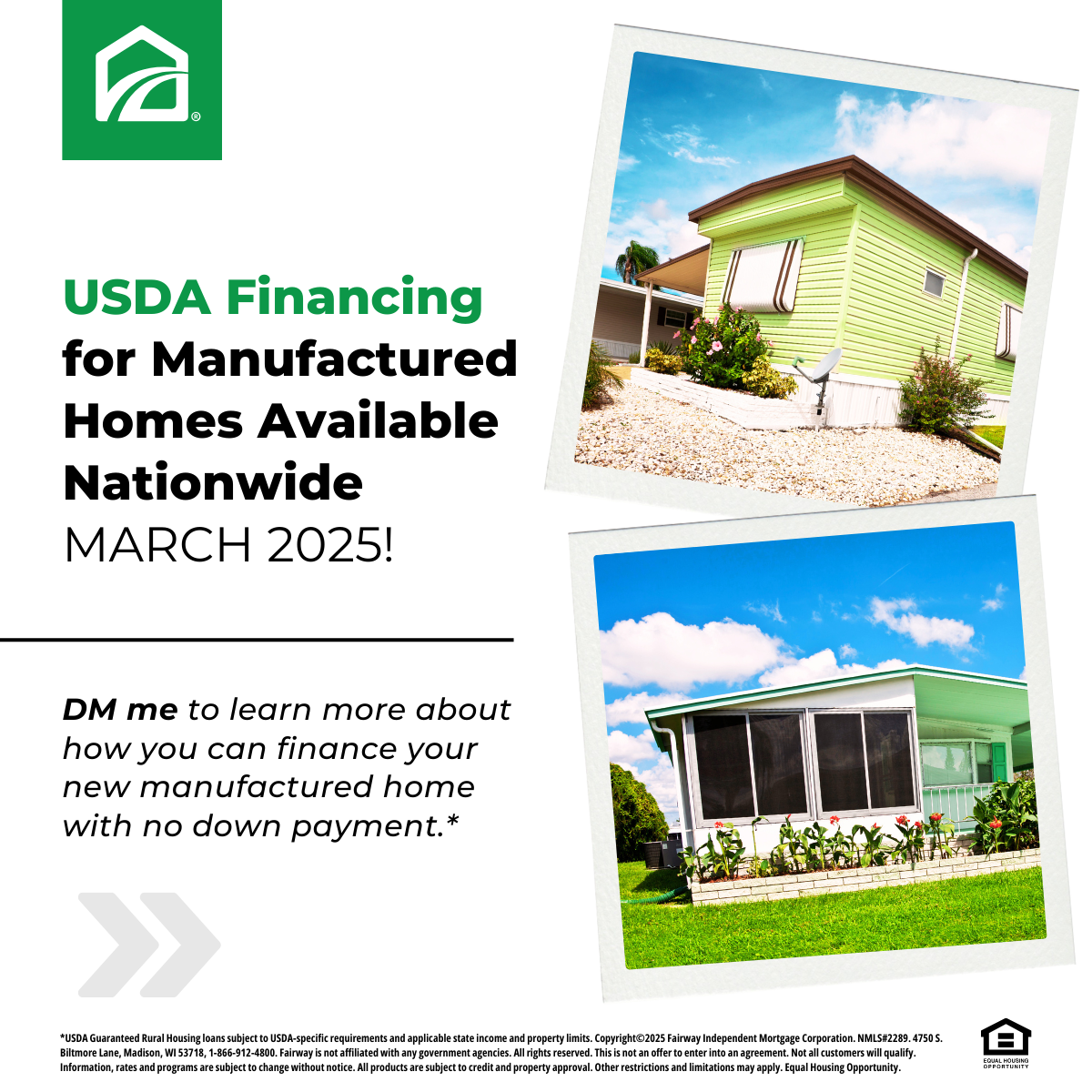
USDA Financing for Manufactured Homes Available Nationwide in March 2025!

Great news for homebuyers! Starting in March 2025, USDA financing will be available nationwide for manufactured homes, making homeownership more accessible and affordable. This expansion opens doors for buyers looking for quality, cost-effective housing with zero down payment options and competitive interest rates.

The Shumate Team at Fairway Independent Mortgage, is licensed in Georgia, Alabama, Tennessee, North Carolina, South Carolina, and Florida, and we’re ready to help you navigate the process. Whether you’re a first-time homebuyer or looking for an affordable housing option, a USDA loan could be the perfect fit.

Why Choose a USDA Loan for a Manufactured Home?
✅ Zero Down Payment – No need for a hefty upfront investment
✅ Low Interest Rates – Enjoy competitive financing options
✅ Flexible Credit Requirements – Making homeownership more attainable
✅ Available in Eligible Rural Areas – Many locations qualify under USDA guidelines

If you’re considering a manufactured home, now is the time to start preparing! Our team is here to guide you through the process and help you take advantage of this fantastic opportunity.

📞 Contact us today at 404-791-3155 to learn more and see if a USDA loan is right for you!

Chris Shumate

Sales Manager/ Loan Officer

678.541.5581   Office

404.791.3155   Mobile

chriss@fairwaymc.com

Apply Online: www.chrisshumatefairway.com

Download my app: https://mtgpro.co/fr1l0

3453 Lawrenceville-Suwanee Rd, Suite D | Suwanee, GA.  30024

NMLS #627360 | FIMC #2289

*Licensed in GA, FL, AL, TN, SC, NC